Facebook
 X
X
 Pinterest
 Copy Link
Housing Forecast: 6 Predictions for 2026

The following is a summary of Windermere Principal Economist Jeff Tucker’s six predictions for the U.S. housing market and economy in 2026. He goes into more detail about his predictions in the video below.
1. Existing Home Sales Will Pick Up (Barely)
Home sales have hovered near generational lows for three years. While a sharp rebound is unlikely, conditions point to a modest uptick in 2026. Inventory levels are higher than they’ve been since 2019, and mortgage rates are lower than they’ve been since 2022. Together, those factors should lift existing home sales—but not by much.
2. Home Prices Will Be Roughly Flat
Home prices are likely to remain flat in 2026, largely due to higher inventory putting downward pressure on values. The Case-Shiller Home Price Index showed small declines last summer, though that trend faded by fall. Sellers have been highly responsive to market shifts, often de-listing when offers fall short or holding off on listing altogether. That restraint has kept prices from falling further despite growing supply
3. Inventory Will Climb to Pre-Pandemic Levels
The number of homes for sale will likely return to pre-pandemic levels in 2026, possibly as early as spring. Inventory rose sharply in 2025, and a “shadow supply” of homes—those whose owners are waiting for better conditions—remains in the wings. Many “discretionary sellers” will continue testing the market, holding out for the right price. That behavior should extend average time on market and boost total listings, giving buyers more options and negotiating power.
4. The Homeownership Rate Will Decline
At current prices and interest rates, homeownership remains out of reach for many middle-class Americans who would have bought in different conditions. Slower rent growth has also reduced urgency among would-be buyers, encouraging them to stay put. More renters are opting for single-family homes to enjoy the space and lifestyle of ownership without a mortgage, a shift that will help push the overall homeownership rate slightly lower.
5. Mortgage Rates Will Decline Slightly
Mortgage rates should remain below 6.25% for most of 2026 and could briefly dip under 6%. The Fed’s rate cuts and slower growth have brought 10-year Treasury yields near 4%, while the spread between Treasuries and mortgage rates has narrowed toward its normal range of 2% or less. That trend is expected to continue as refinance risk on mortgage-backed securities gradually fades, but much of the improvement is already reflected in current rates, so significant declines are unlikely.
6. We Will Avoid a Recession in 2026
The U.S. economy weathered several shocks in 2025 but avoided a downturn. Payroll gains have slowed, though more due to shrinking labor supply than weak demand, and unemployment claims have remained stable. After early trade policy turbulence, corporate earnings rebounded strongly, and tariff concerns have faded as court challenges and new trade deals rolled back some of the costliest restrictions.
This article originally appeared on the Windermere blog December 2, 2025.

We earn the trust and loyalty of our brokers and clients by doing real estate exceptionally well. The leader in our market, we deliver client-focused service in an authentic, collaborative, and transparent manner and with the unmatched knowledge and expertise that comes from decades of experience.
© Copyright 2025, Windermere Real Estate/Mercer Island.
Adding an ADU? Here’s a Guide to Permits & Regulations…

ADUs and DADUs are increasingly popular among homeowners looking to maximize their property value. For many cities in Washington State, the recent enactment of House Bill 1337 has made it easier for homeowners to add an ADU/DADU by loosening restrictions on them in residential areas. Other states have enacted similar laws as municipalities across the country try to address our shortage of “middle” affordable housing.
As the movement of short-term rentals, turnkey properties, and real estate investment continues to grow, it’s worth it to take a moment and understand the regulations that dictate a property’s potential—especially before you buy. Understanding a bit about the permitting process will also help you avoid getting bogged down in legalities when trying to build structures on your property.
What is an ADU, and do I need a permit to build one?
 Accessory Dwelling Units (ADUs) and Detached Accessory Dwelling Units (DADUs) are essentially guest quarters that offer independent living space for renting out or accommodating multi-generational family members. Typically, they include a separate entrance, kitchen, living area, bedroom, and bathroom. Common examples are a basement apartment, converted garage, backyard cottage, or prefab modern shed. They’re a great way to get the highest return on your property investment. Before you break ground on your building project, however, here are some of the things you should keep in mind.
- Permits and Regulations: No matter where you live, it is necessary to obtain an appropriate permit before you begin the construction/conversion process. Permits ensure that your project complies with local building codes and regulations (and also allow you to count that square footage as living space when you sell the property or have it appraised). Here are ADU regulations for King County, or check with your local city/county.
- Code Compliance: Building codes aren’t just red tape for the sake of red tape; they exist to make sure that all buildings are safe. Whether you’re building the structures on your property yourself or hiring a professional to do the job, familiarize yourself with your local codes and regulations. In the city of Seattle, HB 1337 allows homeowners to build at least two 1,000 sq. ft. ADUs per lot (whether attached or detached). Contact your local zoning department or building authority to learn more.
- Applying for a Permit: The permit application process varies by location. Typically, you’re required to submit detailed plans for your project with documents that outline its scope, size, etc. Whether you submit architectural drawings, engineering plans, or some other form of detailed blueprint, be prepared for a thorough review on behalf of your local authority to make sure your project complies with the rules.
Whatever project you have in mind—whether converting existing structures or building new ones—it’s important to become well-versed in the permits and regulations that will allow you to get it approved hassle-free. Consult with local authorities to get the full picture of what’s required from you. Once you’ve checked all the boxes, you’ll be well on your way to maximizing the value of your property.
Curious what your return on investment might be when it’s time to sell? Contact me for a Comparative Market Analysis. I can also put you in touch with a property management company to estimate market rental rates in your area.
Adapted from an article that originally appeared on the Windermere blog September 6, 2023.
We earn the trust and loyalty of our brokers and clients by doing real estate exceptionally well. The leader in our market, we deliver client-focused service in an authentic, collaborative, and transparent manner and with the unmatched knowledge and expertise that comes from decades of experience.
© Copyright 2025, Windermere Real Estate/Mercer Island.
2025-2026 Football & Hockey Schedules, Recipes, & Tips

Football is almost here and hockey is coming in hot behind it! Scroll down for printable schedules, tailgating hacks (including how to pack the perfect cooler!), and favorite gameday recipes. Fans of all ages will also love our printable football and hockey bingo sheets.
Need to brush up on your sports lingo? Check out Wikipedia’s handy football and hockey glossaries. You can say impressive things like, “Are they running a 3-4 defense?” and “It’s not icing unless the puck passes the goal line…”






We earn the trust and loyalty of our brokers and clients by doing real estate exceptionally well. The leader in our market, we deliver client-focused service in an authentic, collaborative, and transparent manner and with the unmatched knowledge and expertise that comes from decades of experience.
© Copyright 2025, Windermere Real Estate/Mercer Island.
Are You Paying Too Much for Property Taxes?

OK nobody panic, but it’s almost…TAX TIME. For Washington State homeowners, this means you’ve probably received a little postcard letting you know your property’s assessed value and taxes due for 2025. Those with a mortgage on their home may be tempted to file this away and let the bank take care of it (after all, that’s what your mortgage escrow fund is for). However, everyone should take a close look no matter who is writing the check—you may be over-paying taxes if your home’s assessment is above fair market value. You or a loved one who is a low-income senior or disabled may also be paying too much if you haven’t taken advantage of available exemptions. Read on for solutions to these issues as well as important deadlines to keep you on track. (Looking for income tax tips, too? Check out this article for homeowners.)
Assessments & Valuation | Exemptions & Deferrals | Important Dates
Assessments & Valuation
Each county has an assessor tasked with appraising real property at its true and fair market value, according to the highest and best use of the property. Fair market value is defined as, “the amount that a willing and unobligated buyer is willing to pay a willing and unobligated seller.” While three appraisal methods are accepted, the most common approach is to estimate value based on sales of similar properties. This is known as the Market or Sales Comparison approach and is typically pretty accurate. In fact, it’s what real estate agents use when they prepare CMA valuation estimates.
However, the county’s assessed value can be incorrectly high for a number of reasons. For example, if your property suffered recent damage or depreciation that wasn’t taken into account (physical inspections are only required once every six years). The highest and best use might also be incorrect, such as vacant land that is assessed as develop-able but in fact cannot support a septic system.
If you feel your assessment is too high, there are a number of steps you can take. A good first step is to contact your local county assessor’s office. You can request copies of the comparable sales that were used to appraise your property’s value, and can also inform them of any errors or information that should have been taken into account. Disagreements are often settled at this level without any further action needed.
If you can’t come to a resolution with the assessor, the next step would be to file an appeal with your county’s board of equalization (BOE). If you or the assessor disagrees with the BOE’s decision, it can then be appealed to the State Board of Tax Appeals (BTA). In some cases, the decision made by the BTA can also be appealed in Superior Court. Keep in mind that any appeal you make will require you to provide market evidence that the assessed value does not truly reflect the fair market value.
Exemptions & Deferrals
Low-income senior homeowners who are age 61+ or people unable to work due to a disability (or their surviving spouses/domestic partners age 57+) may be eligible for a property tax exemption. This lowers the amount of taxes that are owed each year. For King County, the maximum income is $84,000 (find income guidelines for other counties here).
Seniors, low-income or disabled people who don’t meet the guidelines for an exemption may still be eligible for a property tax deferral. While this doesn’t reduce the taxes owed, it does allow you to defer taxes (including special assessments and back taxes) as a lien on the property that can be repaid either as funds become available or when the property is sold. 5% interest is assessed on the deferred amount.
Find application info plus more property tax relief programs in this article on Property Tax Relief Programs.
Important Dates
January 1st: Property is valued for taxes due in the next year.
March 31st: Applications are due for the Senior/Disabled Deferral and Widow/Widower Assistance.
April 30th: The first half of property taxes are due (or full amount if you owe less than $50).
May 1st: 1% per month (12% per annum) is assessed on any overdue taxes.
June 1st: A 3% penalty is assessed for any overdue taxes in the current year.
July 1st: Deadline to file an appeal with the County Board of Equalization (BOE) for the current year’s assessment (or 30 days from the date of notification if it’s later).
August 31st: New construction is placed on the assessment roll based on the valuation determined July 31st.
September 1st: Applications for the Limited Income Deferral are due.
October 31st: The second half of property taxes are due.
December 1st: An 8% penalty is assessed for any overdue taxes in the current year.
December 31st: Property tax exemption applications are due for seniors and those with disabilities.
For more info, contact the Washington State Department of Revenue at dor.wa.gov or (360) 705-6705. You can also find a lot of great info in their Homeowner’s Guide to Property Tax publication.
Psst…I love giving you these helpful tips but they can’t replace the advice of your tax professional. Reach out to your pro for counsel on the best course of action for your unique situation.
We earn the trust and loyalty of our brokers and clients by doing real estate exceptionally well. The leader in our market, we deliver client-focused service in an authentic, collaborative, and transparent manner and with the unmatched knowledge and expertise that comes from decades of experience.
© Copyright 2025, Windermere Real Estate/Mercer Island.
2024 Football & Hockey Schedules, Recipes, & Tips

Football is almost here and hockey is coming in hot behind it! Scroll down for printable schedules, tailgating hacks (including how to pack the perfect cooler!), and favorite gameday recipes. Fans of all ages will also love these printable football and hockey bingo sheets.
Need to brush up on your sports lingo? Check out Wikipedia’s handy football and hockey glossaries. You can say impressive things like, “Are they running a 3-4 defense?” and “It’s not icing unless the puck passes the goal line…”







We earn the trust and loyalty of our brokers and clients by doing real estate exceptionally well. The leader in our market, we deliver client-focused service in an authentic, collaborative, and transparent manner and with the unmatched knowledge and expertise that comes from decades of experience.
© Copyright 2024, Windermere Real Estate/Mercer Island.
What You Need to Know about the Washington State Seller Property Disclosure – Form 17

Washington State requires sellers of residential real property to thoroughly disclose material facts on a form called the Residential Real Property Disclosure Statement (often referred to as Form 17). Unless the buyer has expressly waived their rights, the seller must deliver this completed disclosure within 5 days after mutual acceptance. The buyer then has a window of time to walk away with their earnest money at their discretion.
While sellers have always been required to disclose material facts, the Form 17 has been required by law (RCW 64.06.020) since January 1, 1995. It has undergone ten revisions since its inception, the last of which went into effect in 2021. In addition to the residential disclosure, the state added an unimproved property (land) disclosure in 2007 (RCW 64.06.015) and a commercial property disclosure in 2012 (RCW 64.06.013). The current form is 6 pages long and includes most of the typical property issues requiring disclosure with a catchall question for anything left out.
Is every seller required to complete this form? Are there exemptions?
The statute allows very limited exceptions RCW (64.06.010) to completing the disclosure statement. They include transfers…
- by foreclosure or deed-in-lieu of foreclosure
- that are gifts to a parent, spouse, domestic partner, or child
- related to marital dissolution or dissolution of a state registered domestic partnership
- to buyers who had a prior ownership interest in the property in the last two years
- of an interest that is less than fee simple
- made by the personal representative of the estate or by a trustee in bankruptcy
- in which the buyer has expressly waived the receipt of the seller disclosure statement
However, if the answer to any of the questions in the section entitled “Environmental” would be “yes,” the buyer may not waive the receipt of the “Environmental” section of the seller disclosure statement.
What happens after delivery of the disclosure statement?
The buyer has three business days from receipt of the disclosure statement to cancel the agreement for the purchase of the property (unless they waived their rights to do so in writing).
This right to rescind is statutory, and the decision to revoke the offer may be made by the buyer at the buyer’s sole discretion. If the buyer elects to rescind the agreement, the buyer must deliver written notice of rescission to the seller within the three-business-day period.
Upon delivery of the written rescission notice the buyer is entitled to immediate return of all earnest money deposits and the agreement for purchase becomes void.
If the buyer does not deliver notice the disclosure statement is deemed approved and accepted by the buyer. The full provisions of this right are found in RCW (64.06.030).
What happens if the seller doesn’t deliver a completed disclosure?
If the seller fails or refuses to provide a disclosure statement to buyer within 5 days, the prospective buyer’s right of rescission extends until the earlier of three business days after receipt of the disclosure statement or the date the transfer has closed (unless the buyer has otherwise waived the right of rescission in writing). After closing, per RCW 64.06.040 (3) the seller’s obligation to deliver the disclosure statement and the buyer’s rights and remedies related to it terminate.
Some sellers are more forthcoming than others…
When sellers claim there are no issues to explain, you should be wary…very wary. In my years of practice, I have yet to see a perfect house. Whether a 10-million-dollar estate, a newly constructed home, or a $300,000 starter home, every house has a story and every buyer has a right to know about it so they can knowledgeably complete their due diligence.
Making full disclosure actually benefits the seller, too. By disclosing a condition, the seller shifts the burden of investigation to the buyer under Washington law. By remaining silent, a seller risks the appearance of concealment and a lawsuit. Think of it this way: disclose an issue and if the buyer accepts it you move forward with no worries since they are barred from seeking compensation later; fail to disclose it and you could be looking over your shoulder for years.
I like to see issues disclosed on a disclosure statement. It makes me feel like the seller has been honest and transparent. When I see a “perfect” disclosure, I know the seller is either in total denial or has decided not to disclosure the little (or big) issues they know about. Most buyers expect far more disclosure from the seller than the law requires. While sellers don’t have a duty to inspect their home or look for defects, they do have a duty to disclose defects that affect the value, physical condition, or title to the property. Sellers should consider disclosure to be a form of insurance.
Instead of minimizing disclosures, a prudent seller will try to consider the property from the perspective of a buyer and then disclose what a buyer would want to know. Many of the conditions that lead to lawsuits would have been acceptable to the buyer if they had been disclosed in advance. Other conditions simply are not important enough to the buyer to fully investigate before purchasing a property. To maximize the benefit of disclosure law, sellers may want to make full disclosure of the property and neighborhood even if they have no legal duty to do so. It is usually better to be over-insured than not insured at all.
Buyers have duties, too…
In addition to a thorough inspection, investigating issues raised in the seller disclosure statement is one of the most important parts of due diligence in a real estate transaction. Buyers have a duty of thoroughness and inspection that should not be taken lightly.
The buyer should evaluate each disclosed item, and (especially) those items not disclosed, but easily discovered during a walk-through and inspection. If there are many items identified and not disclosed, a buyer should be concerned about other unseen issues that might also not be disclosed. A savvy buyer will investigate a home with limited disclosure more thoroughly and/or make the decision not to purchase form a seller who is seemingly not transparent with the truth.
It is also important to note that sellers typically have no duty to disclose neighborhood conditions or past events at the property, even though these may be issues of concern to the buyer. For instance, sellers usually have no legal duty to disclose the following conditions either at the property or in the neighborhood:
- Death, murders, suicides, rapes or other crimes
- Ongoing criminal or gang activity in the neighborhood
- Registered sex offenders in the neighborhood (RCW 64.06.021)
- Future development in the area
- Political or religious activities in the area
If these or similar matters are of concern, buyer should conduct their due diligence prior to submitting an offer or include an inspection and “Neighborhood Review” contingency in the offer to allow them time to complete it as part of their purchase agreement.
What is the seller’s responsibility after delivery of disclosure statement?
The disclosure statute (64.06.040) states that if after delivering a completed disclosure statement, the seller learns from a source other than the buyer or others acting on the buyer’s behalf such as an inspector of additional information or an adverse change which makes any of the disclosures made inaccurate, the seller shall amend the real property transfer disclosure statement, and deliver the amendment to the buyer. The buyer then has the right to rescind the purchase agreement within three business days after receiving the amended disclosure statement.
No amendment is required if the seller takes whatever corrective action is necessary so that the accuracy of the disclosure is restored, or the adverse change is corrected, at least three business days prior to the closing date.
The seller disclosure statement is not a warranty
RCW 64.06.050 says the seller shall not be liable for any error, inaccuracy, or omission in the disclosure statement if the seller had no actual knowledge of the error, inaccuracy, or omission. This includes disclosures based on information provided by public agencies, or by other persons providing information within the scope of their professional license or expertise, including, but not limited to, a report or opinion delivered by a land surveyor, title company, title insurance company, structural inspector, pest inspector, licensed engineer, or contractor. This applies to the seller’s real estate broker as well.
This should give a conscientious seller the assurance that the statute provides for property disclosure only and is not a warranty of current or ongoing condition. Provided a seller discloses everything they know, or that a reasonable seller should have known, about their property, a seller should feel good in knowing they are not held liable for its condition.
Here are a few great online resources to add to your knowledge base:
Current local Form 17 Real Property Transfer Disclosure Statement: https://windermeremi.com/files/2024/05/17_SellerDiscl.pdf
The complete text of the Washington State Real Property Transfer Act: https://app.leg.wa.gov/RCW/default.aspx?cite=64.06&full=true
NOLO Article: https://www.nolo.com/legal-encyclopedia/residential-home-sellers-washington-what-the-law-requires-you-disclose.html
Of course, nothing tops having an experienced pro to guide you through the process. We’ve seen hundreds upon hundreds of homes and can help you identify the solid finds from the duds with gorgeous looking veneer.
Choosing the right broker can save you thousands on your home purchase. Whether through local market knowledge and pricing analysis allowing you to make a smarter offer, recommendations and resources to thoroughly conduct your due diligence and avoid costly mistakes, or savvy contract negotiation to help you get the terms you need, having a Windermere broker on your side is an advantage you can’t afford to sacrifice.
We earn the trust and loyalty of our brokers and clients by doing real estate exceptionally well. The leader in our market, we deliver client-focused service in an authentic, collaborative, and transparent manner and with the unmatched knowledge and expertise that comes from decades of experience.
© Copyright 2020-2024, Windermere Real Estate/Mercer Island. Originally written by Julie Barrows.
Q4 2022 Western Washington Economic & Real Estate Update

The following analysis of select counties of the Western Washington real estate market is provided by Windermere Real Estate Chief Economist Matthew Gardner. I hope that this information may assist you with making better-informed real estate decisions. For further information about the housing market in your area, please don’t hesitate to contact me.
Regional Economic Overview
Although the job market in Western Washington continues to grow, the pace has started to slow. The region added over 91,000 new jobs during the past year, but the 12-month growth rate is now below 100,000, a level we have not seen since the start of the post-COVID job recovery. That said, all but three counties have recovered completely from their pandemic job losses and total regional employment is up more than 52,000 jobs. The regional unemployment rate in November was 3.8%, which was marginally above the 3.7% level of a year ago. Many business owners across the country are pondering whether we are likely to enter a recession this year. As a result, it’s very possible that they will start to slow their expansion in anticipation of an economic contraction.
Western Washington Home Sales
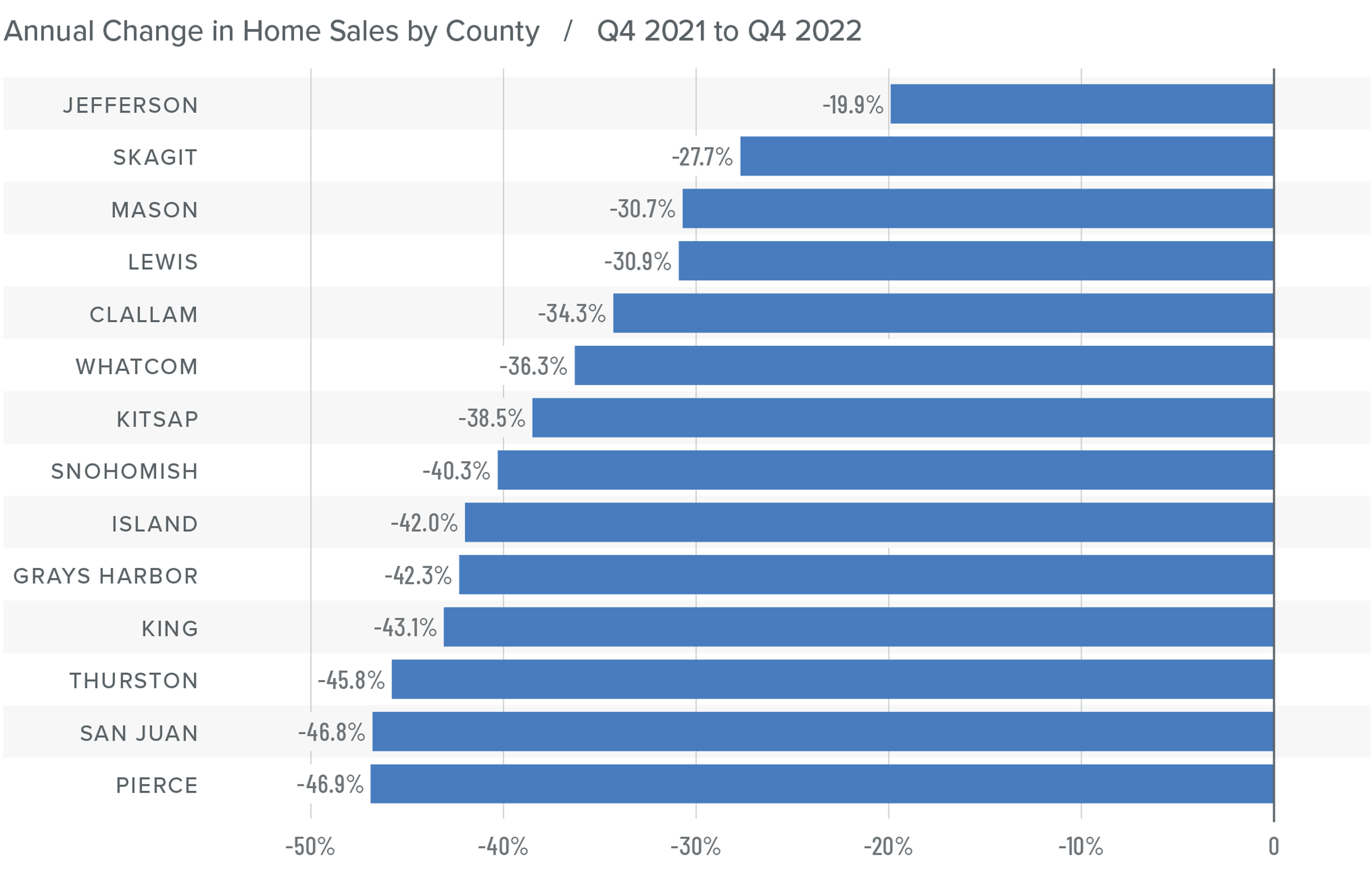
❱ In the final quarter of 2022, 12,711 homes sold, representing a drop of 42% from the same period in 2021. Sales were 34.7% lower than in the third quarter of 2022.
❱ Listing activity rose in every market year over year but fell more than 26% compared to the third quarter, which is expected given the time of year.
❱ Home sales fell across the board relative to the fourth quarter of 2021 and the third quarter of 2022.
❱ Pending sales (demand) outpaced listings (supply) by a factor of 1:2. This was down from 1:6 in the third quarter. That ratio has been trending lower for the past year, which suggests that buyers are being more cautious and may be waiting for mortgage rates to drop.
Western Washington Home Prices
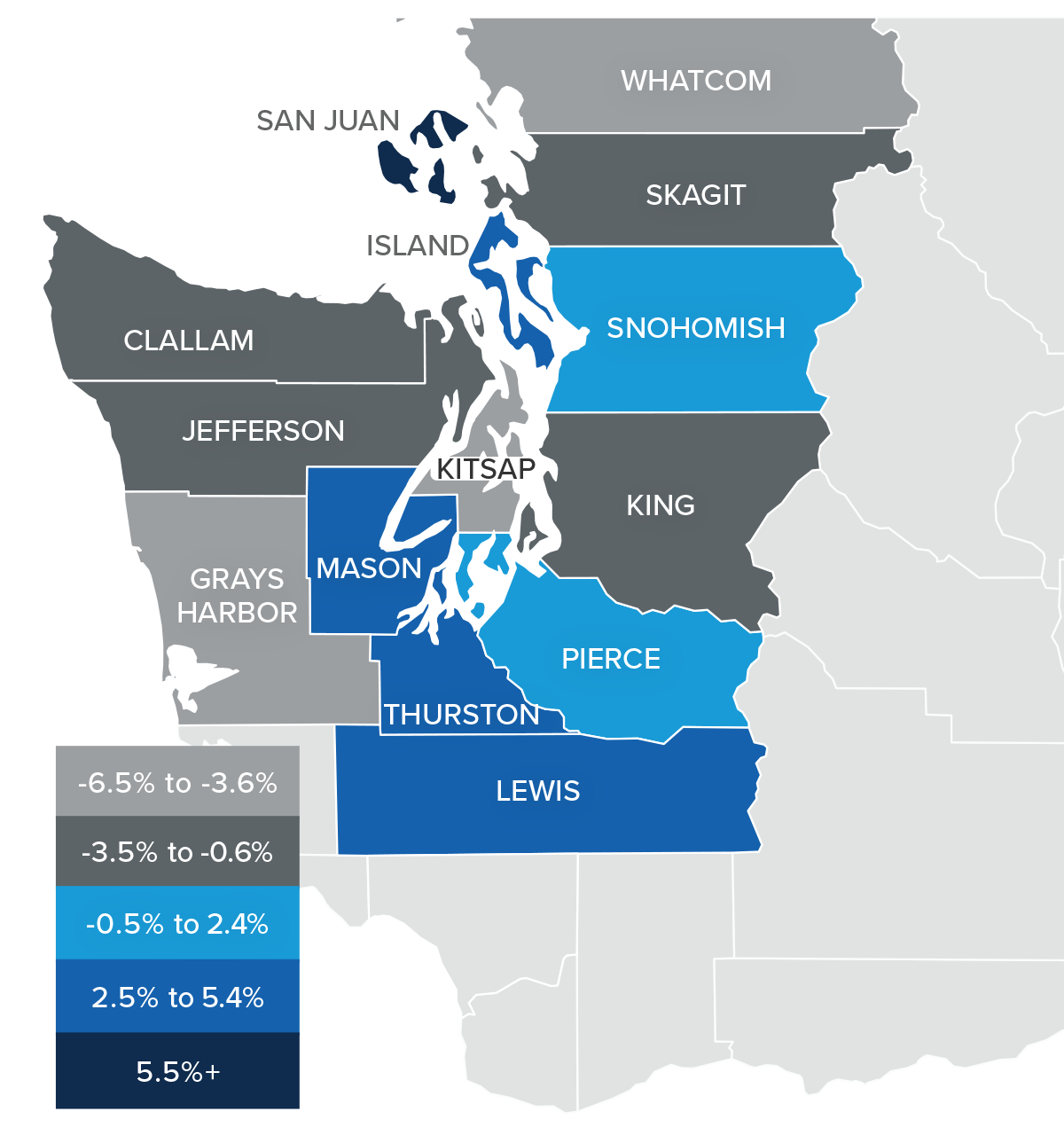
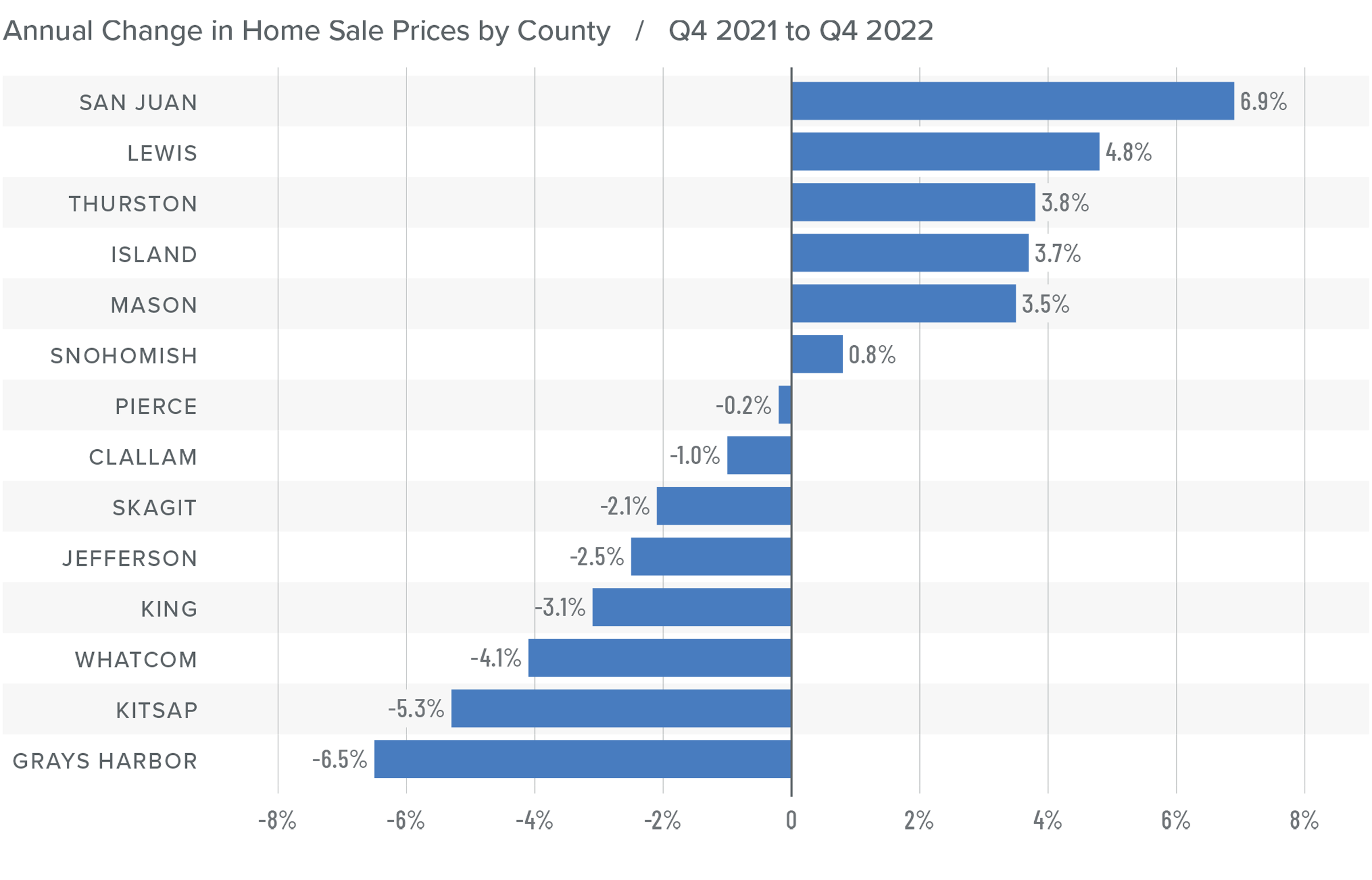
❱ Sale prices fell an average of 2% compared to the same period the year prior and were 6.1% lower than in the third quarter of 2022. The average sale price was $702,653.
❱ The median listing price in the fourth quarter of 2022 was 5% lower than in the third quarter. Only Skagit County experienced higher asking prices. Clearly, sellers are starting to be more realistic about the shift in the market.
❱ Even though the region saw aggregate prices fall, prices rose in six counties year over year.
❱ Much will be said about the drop in prices, but I am not overly concerned. Like most of the country, the Western Washington market went through a period of artificially low borrowing costs, which caused home values to soar. But now prices are trending back to more normalized levels, which I believe is a good thing.
Mortgage Rates
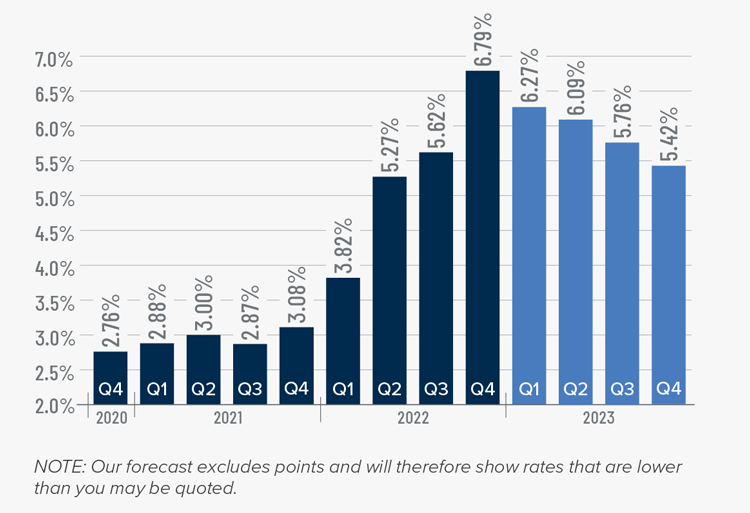
Rates rose dramatically in 2022, but I believe that they have now peaked. Mortgage rates are primarily based on the prices and yields of bonds, and while bonds take cues from several places, they are always impacted by inflation and the economy at large. If inflation continues to fall, as I expect it will, rates will continue to drop.
My current forecast is that mortgage rates will trend lower as we move through the year. While this may be good news for home buyers, rates will still be higher than they have become accustomed to. Even as the cost of borrowing falls, home prices in expensive markets such as Western Washington will probably fall a bit more to compensate for rates that will likely hold above 6% until early summer.
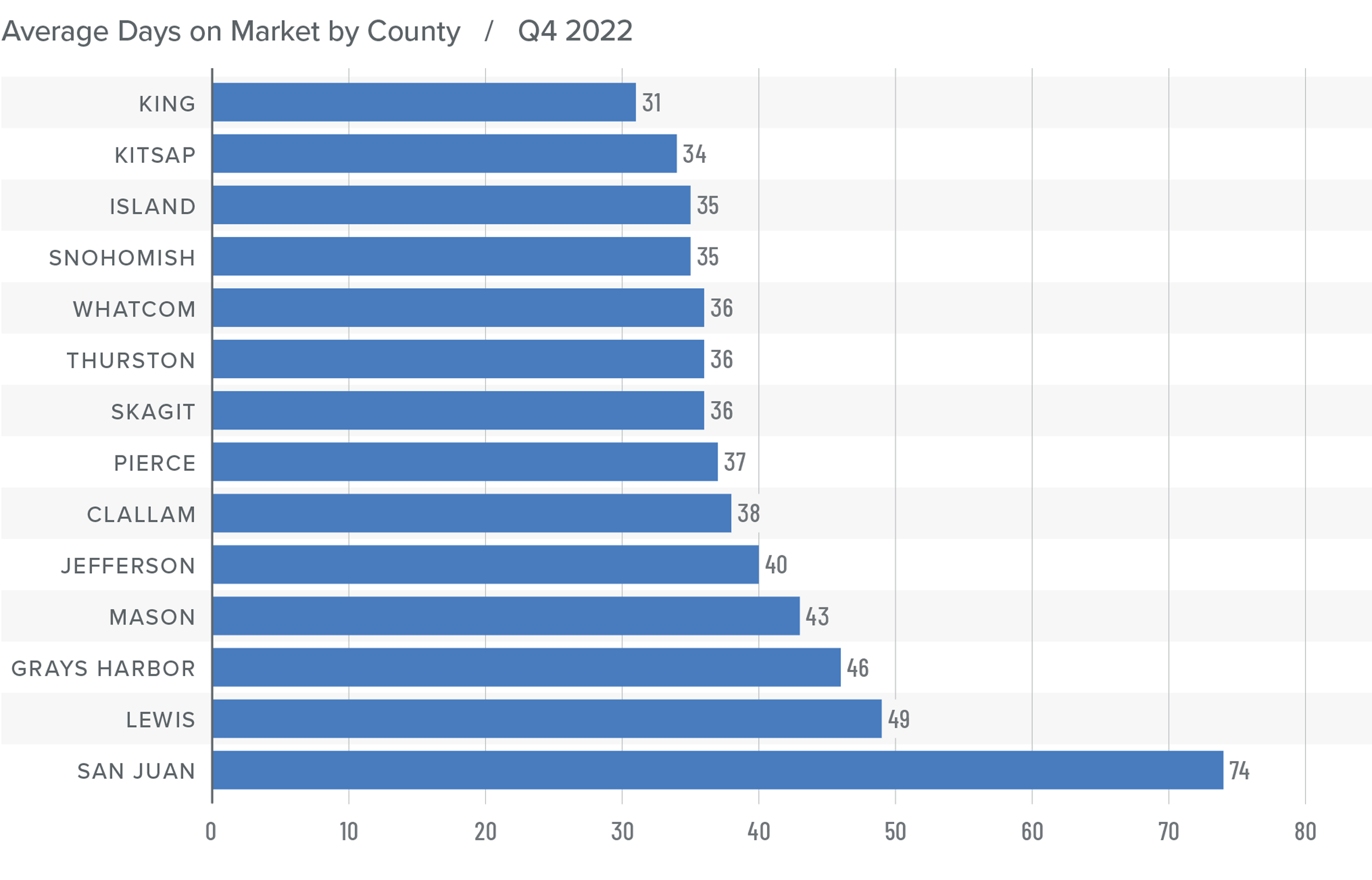
Western Washington Days on Market
❱ It took an average of 41 days for homes to sell in the fourth quarter of 2022. This was 17 more days than in the same quarter of 2021, and 16 days more than in the third quarter of 2022.
❱ King County was again the tightest market in Western Washington, with homes taking an average of 31 days to find a buyer.
❱ All counties contained in this report saw the average time on market rise from the same period a year ago.
❱ Year over year, the greatest increase in market time was Snohomish County, where it took an average of 23 more days to find a buyer. Compared to the third quarter of 2022, San Juan County saw average market time rise the most (from 34 to 74 days).
Conclusions
This speedometer reflects the state of the region’s real estate market using housing inventory, price gains, home sales, interest rates, and larger economic factors.
The regional economy is still growing, but it is showing signs of slowing. Although this is not an immediate concern, if employees start to worry about job security, they may decide to wait before making the decision to buy or sell a home. As we move through the spring I believe the market will be fairly soft, but I would caution buyers who think conditions are completely shifting in their direction. Due to the large number of homeowners who have a mortgage at 3% or lower, I simply don’t believe the market will become oversupplied with inventory, which will keep home values from dropping too significantly.

Ultimately, however, the market will benefit buyers more than sellers, at least for the time being. As such, I have moved the needle as close to the balance line as we have seen in a very long time.
About Matthew Gardner

As Chief Economist for Windermere Real Estate, Matthew Gardner is responsible for analyzing and interpreting economic data and its impact on the real estate market on both a local and national level. Matthew has over 30 years of professional experience both in the U.S. and U.K.
In addition to his day-to-day responsibilities, Matthew sits on the Washington State Governors Council of Economic Advisors; chairs the Board of Trustees at the Washington Center for Real Estate Research at the University of Washington; and is an Advisory Board Member at the Runstad Center for Real Estate Studies at the University of Washington where he also lectures in real estate economics.
This article originally appeared on the Windermere blog January 26th, 2023. Written by: Matthew Gardner.

© Copyright 2023, Windermere Real Estate/Mercer Island.